

A belief in equity and human rights
For the past 12 years, Kay has dedicated his career towards disability rights and inclusion. He began his career working for the National Disability Organisation in Korea where he focused on international programs on disability inclusion. But for Kay, he was always seeking a career that aligned with his humanitarian values.
‘I was inspired by a strong belief in equity and human rights… I wanted to contribute to a global effort that supports vulnerable people, especially people with disabilities who were affected by conflict and displacement,’ said Kay.
‘I believe for humanitarians [in the disability inclusion sector]; we are really providing life-saving services for people with disabilities because they are already living in dire situations. They really need urgent support. So, being a Disability Inclusion Officer, when your organisation designs programs for humanitarian assistance – I’m the one who provides technical assistance for them to consider: how can our program be disability inclusive?’
Visibility on people with disabilities
Cox’s Bazar is the world’s largest refugee camp with around one million Rohingya people, many of them fleeing their homes in 2017 following large-scale persecutions, violence and human rights violations in Myanmar.
‘Before I joined UNHCR, I wondered – how many refugees are living with disabilities here? That’s the first question on my mind and that was the first action I took when I arrived in Cox’s Bazar. When I looked at the data from the UNHCR system, it was 0.8% – less than 1%. It was very small and if you look at the situation: there is over 1 million people here. I felt that it cannot be true, there was something wrong with the data,’ reflected Kay.
Globally, the UN estimates that 15% of the world’s population is living with a disability. A key focus for Kay throughout his deployment was to understand the data collected by UNHCR, and how people with disabilities were underrepresented in Cox’s Bazar. He believes that good-quality data leads to good service provision.
‘It’s not about the number. It’s their story, their life as a person, but [the number] it’s just a start. With these small numbers: not many organisations or its people will pay attention, because they are busy with all the other work – you know, the ‘big numbers’. They are focused on the majority of the group, the majority concern of the majority population. So, this small population with disability continues to be excluded from service provision,’ explained Kay.
It’s not about the number. It’s their story, their life as a person, but [the number] it’s just a start.
While there is a globally agreed standardised tool for collecting disability data (Washington Group Questions on Disability), Kay realised that it wasn’t applied in Cox’s Bazar before he joined. Kay believes that disability data was only collected from visual cues, due to the lack of prioritisation for collecting data on people with disabilities since the initial surge in 2017.
‘In 2017, we had huge numbers of Rohingya people evacuating from Myanmar. There was very limited time for our registration teams to collect all the necessary information to get the profile of people fleeing, which helped inform our program design. When you look at the process, it took at least one hour for one family group (an average of five people per family). One hour for simple biometric information. Unfortunately, nobody checked whether they could collect disability data as well, because disability data is like additional data… So, that’s why they could only figure it out with visual cues. They just collected [that] information. The identification of people with disabilities was unfortunately not prioritised,’ said Kay.
This was also complicated by cultural differences and stigma, when it came to people with disabilities self-reporting.
‘Rohingya people have a lot of cultural beliefs and stigma on disabilities. They believe that the disability is something you did badly from your previous life. You know, something that you should not be proud of in having these members of disability in your culture. They were stigmatised by people and the community members around them.’
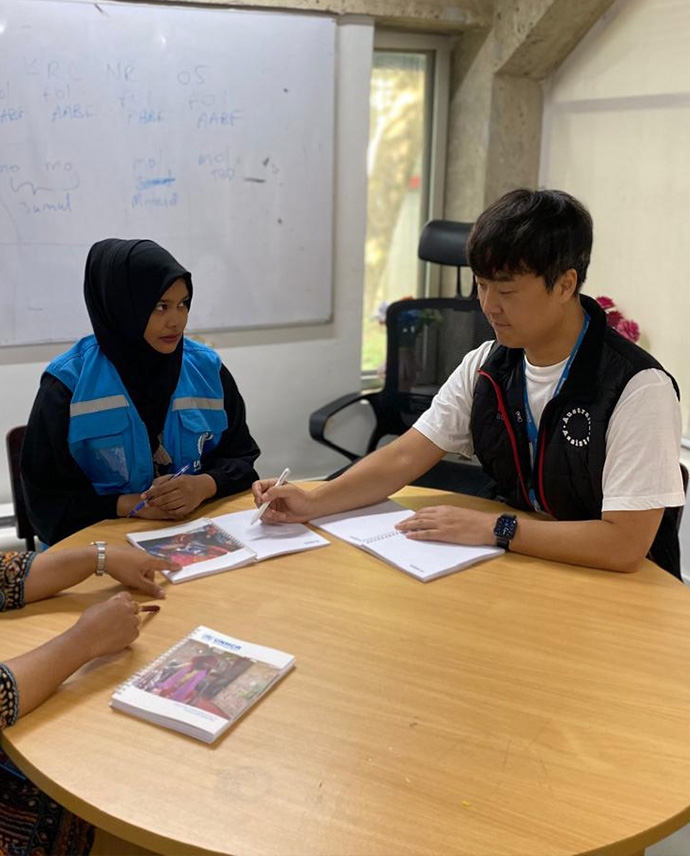
Kay focused on training UNHCR’s Registration Units on the Washington Group Questions. He faced a lot of internal roadblocks, particularly around people’s self-perceptions and beliefs on people with disabilities.
‘I got a lot of feedback, not all of it was good… A lot of people said to me: “I don’t think I’m the right person to assess disability… I kept telling them that the purpose of collecting disability data is not to diagnose their disability. No, we need that data because we want to provide them relevant services based on their information,’ said Kay.
At the end of Kay’s deployment, UNHCR’s disability prevalence data within Cox’s Bazar significantly increased:
‘Disability prevalence rate has increased a lot – four times… It was 0.8% when I joined UNHCR in 2021, but now – when you look at the disability prevalence data for November 2024 – it was 3.05%… This number increased because our UNHCR staff and partners are well-equipped with the knowledge and the importance of disability data collection.’
While he acknowledges there is still a long way to go, Kay feels confident in seeing this progress: ‘This is a big success, I can say that.’
Fostering an inclusive culture
Beyond traditional capacity building, Kay also believed in the importance of fostering a culture of disability inclusion. He introduced his own session, known as ‘Tuesdays with Kay’ with the intention to change people’s perceptions towards people with disabilities.
‘I asked them: “How many days in your life do you really think about disability or disability inclusion?” Not many people have ever thought about disability in their life. So, my second question was: “How many friends, contacts in your mobile phone has a disability?” Basically, none. So, it makes sense. You have no time to think about disability. There’s no one in your family. There’s no one in your friends. But if you have someone in your family, your cousin, your friend, things are very different,’ said Kay.
Kay began this idea to urge people to think about people with disabilities, especially those that have fled conflict, at least once a week. He chose Tuesday. Over the course of three years with the UNHCR, Kay trained more than 1,500 people on disability inclusion. This helped him understand how people think about people with disabilities and the information they needed.
This also expanded into his strong desire to ensure a disability inclusive culture continued beyond his time in Cox’s Bazar. With the success of ‘Tuesdays with Kay’, he also proposed the concept of ‘Disability Inclusion Champions’. He looked for support from UNHCR senior management to send him a list of people – one male, one female – from each unit to become a disability inclusion champion.
‘They sent me a total of 48 people from 12 different units. Then, I designed 4 different modules, specifically for them. Many of them had already attended some of my sessions. So, I provided 4 different training modules across 4 days, including 1 whole day for a field visit… Many of them told me: “This was the first time actually to see a refugee with disability.” You know, even though they’ve been working here for more than 10 years,’ said Kay.
At the end, 28 people completed the initiative and are now known as a ‘Disability Inclusion Champion’ for 2025-26.
‘We made a t-shirt, and we wore the t-shirt on the International Day of a Person with Disability this year. We made a notebook, which had lots of good stories of different types of people with disabilities. We went to the camp to take their picture and collected their stories. We made this notebook for next year [2025] – this is a big achievement. All the senior management and country representatives were very impressed by this awareness-raising campaign on disability inclusion for UNHCR and our partners.’
‘Now we have 1,251 people with disabilities (59% male, 41% female) and their caregivers who have joined these groups. Now they are sharing their concerns, their idea, and how they contribute to their community, you know? How they want to be acknowledged by the community, not just be seen as a big burden of the community’
Listening to local communities
Critical to Kay’s success was also being able to meaningful engage and consult with people with disabilities through listening, respecting and understanding the local ways of working. When Kay began his work with the UNHCR, he observed a key challenge in their way of community consultations.
‘We invited men, women and people with disabilities. But I observed that not many women, and not many people with disabilities were talking in the consultation meeting… I met with them later and had a separate meeting with people with disabilities – different ages and different types, to try and find out why they didn’t share their concerns or ideas for their community,’ said Kay.
‘We figured out later that in the community, they were stigmatised and traumatised by community members treating them badly. So that’s why they didn’t have the courage to talk in front of others. So, myself and a UNHCR colleague tried hard to deliver the message like: “disability is not like that, there’s nothing wrong to have a disability and you are part of the community… You can be a great change maker, and we’d love to support you.” It took many years.’
Through his efforts, he helped establish ‘self-help groups’ across 33 camps: people with disabilities and their caregivers who are actively shaping and providing feedback to UNHCR’s program design and partner service delivery.
‘Now we have 1,251 people with disabilities (59% male, 41% female) and their caregivers who have joined these groups. Now they are sharing their concerns, their idea, and how they contribute to their community, you know? How they want to be acknowledged by the community, not just be seen as a big burden of the community,’ reflected Kay.
Kay also embedded good practices to foster meaningful and inclusive partnerships with UNHCR’s implementing partner, Humanity & Inclusion (HI – formerly known as Handicap International). Kay’s ability to understand the UNHCR’s priorities, but also implementing partners, such as HI, was vital to his success. He believes that a strong partnership is reciprocal: ‘to have a good partner, we need to be a good partner first.’
‘Being a partner is not easy, especially from the perspective of an implementing partner… For me, I do go there to monitor the activity. But I always try to tell them, “My monitoring is not to monitor your activities and camp. No, I go to listen to you and see how we can provide better services with you,’ reflects Kay.
‘The more I understand about our partner’s activities, including their concerns and challenges – the easier I can bring these issues into internal discussions in UNHCR. So rather than just pushing our partner to do this thing, or that thing, without knowing – it’s very important to consider them, their situations, challenges and their resources. It’s very important to consider [all these things] before we approach them with our ideas. I think, that’s why the partner always sees me as part of them, which I am very happy with that… We have a mutual respect and trust for each other.’
Australia’s humanitarian action
Throughout Kay’s deployment in Cox’s Bazar, his success in improving disability data collection, fostering a disability inclusive culture, and meaningfully listening and working collaboratively with local communities and partners reflects strongly on Australia’s humanitarian action and its deep commitment to disability equity and rights.
‘I really appreciate the Australia Assists program because among many roster programs, [only] a few has prioritised disability inclusion… People here keep saying that one person can change many things, because I’ve changed so many things here, which I’m so happy to hear,’ said Kay.
‘The Australia Assists program has provided the right person, in the right timing, to change the situation in a better way. I can say that with confidence.’
Disclaimer: The information and views published here are the individual’s own and do not necessarily represent the partner organisation, Australia Assists or the Australian Government’s views, positions or opinions.